
The short answer
AI fatigue is the exhaustion of constantly trying, paying for and half-using AI tools with no system behind them. The fix is fewer tools used more deeply: list every AI tool you use, sort each into core, occasional or dead weight, cancel the dead weight, go deeper on one core tool this month, and review the stack once a quarter.
If you have ten AI tabs open right now and can’t remember what half of them were even supposed to fix, you’re not alone. Marketers were told AI would save time. For a lot of us, it’s done the opposite: another tool to learn, another subscription to justify, another “game changing” app in the group chat that makes you feel like you’re already behind.
That exhausted, scattered feeling has a name: AI fatigue. It’s not about AI being bad. It’s about having too much of it, too shallowly, with no plan for any of it. This post breaks down why AI fatigue happens, how to tell if it’s happening to you, and why a smaller, better used tool stack beats a sprawling one every time.
What AI fatigue actually is
AI fatigue is the mental exhaustion that comes from constantly evaluating, adopting, and half using AI tools without ever settling into a system. It shows up as:
- Subscription guilt: paying for four AI tools and only opening one of them regularly.
- Decision fatigue: every new task turns into “wait, is there an AI tool for this?” before you just do the task.
- Tab overload: five AI assistants open, each holding a different piece of context you now have to re-explain.
- Quiet resentment: AI was supposed to free up your time, and instead it feels like a second job just keeping up with it.
None of this means AI isn’t useful. It means the way most marketers are adopting AI right now, one shiny tool at a time, with no system behind it, is unsustainable.
The data points the same way. Gartner found marketing teams used only a third of their martech stack’s capabilities in 2023, and just 11% managed to increase that utilization by more than 10% in a year. Adding tools is easy; getting value from them is the hard part.
Why marketers get hit with AI fatigue harder than most
The pace of new tools outstrips any team’s ability to evaluate them
A new AI marketing tool launches practically every week, and every one of them claims to be the thing that finally fixes your workflow. Even a well resourced team can’t properly test, roll out, and train on that pace of change. Solo marketers and small teams, who make up a huge share of this audience, have even less room to keep up.
Every tool asks you to re-explain your context
Switch from one AI assistant to another and you’re rebuilding context from scratch: your brand voice, your audience, your past campaigns, your goals for the quarter. That re-explaining tax adds up fast, and it’s rarely counted when someone calculates the “time saved” from a new tool.
FOMO is doing a lot of the decision making
A lot of AI tool adoption isn’t driven by a real gap in your workflow. It’s driven by watching someone else post a slick before and after screenshot and thinking you need whatever they’re using. That’s a recipe for a tool stack built on anxiety instead of actual need.
“More tools” quietly became the metric of AI maturity
Somewhere along the way, having a long list of AI tools started to feel like proof you were “ahead.” In practice, the marketers getting the most value are usually the ones using two or three tools extremely well, not the ones with the longest stack.
The case for quality over quantity in your AI stack
Here’s the shift that actually helps: stop asking “what new AI tool should I add” and start asking “which one or two tools, used properly, would cover most of what I need.”
A smaller, deeper AI stack tends to win for a few concrete reasons:
- You get better at prompting the tools you actually use. Depth of use beats breadth of tools almost every time. The marketer who’s spent three months refining prompts in one tool will usually outperform the one bouncing between five tools at a beginner level.
- Context stays in one place. When you consolidate around fewer tools, you’re not constantly re-explaining your brand and goals. The tool starts to “know” your context, which is where the real time savings show up.
- You can actually audit ROI. It’s hard to know if an AI tool is paying for itself when you’re not using it consistently enough to compare before and after. Fewer tools makes that math possible.
- Fatigue drops, and so does subscription creep. A stack of two or three well used tools is easier to manage, budget for, and explain to your team (or your future self reviewing the credit card statement) than a sprawling list of half used ones.
None of this is an argument against trying new tools. It’s an argument against keeping every tool you’ve ever tried, and against treating “I haven’t tried that one yet” as a reason to feel behind.
A simple framework for auditing your AI tool stack
If you’re feeling the fatigue, here’s a practical way to reset without overhauling everything at once.
Step 1: List every AI tool you’re currently paying for or actively using
Include the free ones you open weekly, not just the paid subscriptions. Be honest about what’s actually part of your workflow versus what you signed up for once and forgot about.
Step 2: Sort each tool into one of three buckets
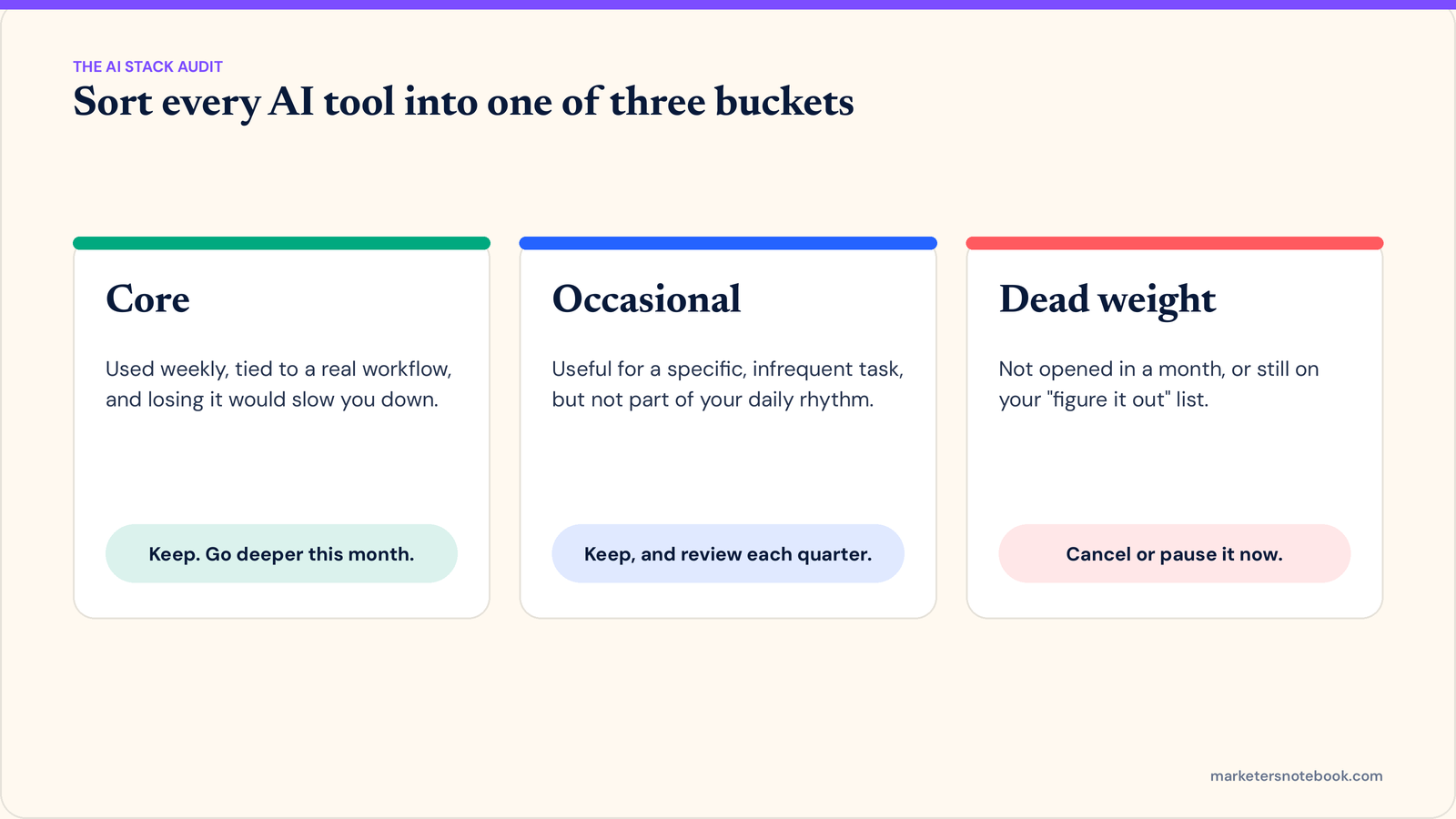
- Core: you use it weekly, it’s tied to a real workflow, and losing it would genuinely slow you down.
- Occasional: useful for a specific, infrequent task, but not part of your daily rhythm.
- Dead weight: you haven’t opened it in a month, or you keep meaning to “figure it out” and never do.
Step 3: Cancel or pause everything in the dead weight bucket
Give yourself permission to cut a tool even if it’s “supposed” to be great. If you’re not using it, it’s not delivering value, no matter how good the demo looked.
Step 4: Pick one core tool to go deeper on this month
Instead of adding something new, spend 30 to 60 minutes learning a feature you’ve never touched in a tool you already pay for. Deeper use of an existing tool almost always beats a new subscription.
Step 5: Set a standing check-in, not a constant one
Once a quarter, revisit your stack. That’s frequent enough to catch real gaps and rare enough that you’re not chasing every new release as it drops.
Signs you’re ready to add a tool, versus signs you’re just tired
Not every urge to add a tool is FOMO, and not every urge to cut one is burnout talking. A quick gut check:
Add a tool if:
- You have a specific, recurring task that’s genuinely slow or painful right now.
- You’ve already tried solving it with what you have, and it’s not working.
- You can name exactly what “success” with the new tool looks like in 30 days.
Hold off (or cut something) if:
- You’re evaluating a tool because someone else posted about it, not because of a task you’re stuck on.
- You can’t clearly say what job the tool would replace or improve.
- Your honest answer to “would I miss this if it disappeared tomorrow” is no.
When the answer is a clear yes, run the new tool through the need, time, budget, shortlist framework before you buy.
Frequently asked questions
What is AI fatigue in marketing?
AI fatigue in marketing is the exhaustion that comes from constantly adopting, evaluating, and shallowly using AI tools without a clear system, leading to subscription overload, decision fatigue, and diminishing returns on the time AI was supposed to save.
How many AI tools should a marketer realistically use?
There’s no universal number, but most marketers get more value from two or three tools used deeply and consistently than from five or more used occasionally. Start from your actual recurring tasks, not from how many tools are available.
How do I know if an AI tool is actually saving me time?
Track it for two to four weeks: how often you open it, how long tasks take with versus without it, and whether you’d notice if it disappeared. If you can’t answer those clearly, it’s probably not earning its place in your stack yet.
Is it bad to try new AI tools?
No, trying new tools is fine and often worthwhile. The problem isn’t trying things, it’s keeping everything you’ve ever tried without periodically cutting what isn’t working, which is how stacks quietly become unmanageable.
What’s the first step to fixing AI fatigue?
List every AI tool you’re currently paying for or using regularly, then sort each one into core, occasional, or dead weight. Cutting the dead weight bucket alone usually brings immediate relief.
The bottom line
You don’t need more AI tools. You need to actually use the ones that are already earning their keep, and be willing to let go of the ones that aren’t. Quality over quantity isn’t a consolation prize for marketers who can’t keep up with every new launch, it’s the strategy that’s actually working for the marketers getting real value out of AI.
If auditing your own stack this week feels daunting, start with just step one above: make the list. That’s usually enough to see where the fatigue is really coming from.
Want more practical, no-hype breakdowns like this one? Follow Marketer’s Notebook on Instagram and LinkedIn (@marketersnotebook) for the next post in this series, and subscribe so you don’t miss it.
1 comment