
The short answer
Build your first marketing team around your biggest gap, not a standard org chart. Hire for the one thing that would hurt the business if it didn’t happen in the next 90 days, write down decisions and ownership as you go so you don’t become the bottleneck, and review the structure every quarter, because the team that works in month one rarely fits month twelve.
The first time I had to build a marketing team from scratch, I assumed the hardest part would be finding good people. It wasn’t. The hardest part was everything nobody warned me about: the hire I made too early, the org structure I copied from a company five times our size, and the six months I spent quietly doing everyone’s job because I hadn’t figured out how to stop doing mine.
If you’re stepping into your first marketing leadership role and staring at an empty org chart, this is the post I wish someone had handed me before I started. Not a generic hiring checklist, but the actual lessons: the ones that only show up once you’re a few hires and a few mistakes in.
Your first hire probably isn’t who you think
Every piece of advice I read before my first build said the same thing: hire a generalist first, someone who can do a bit of everything while the team is small. I did that. It was the wrong call for my situation, and it might be the wrong call for yours too.
A generalist buys you flexibility, but it also means nothing gets done at a level that actually moves the business. What I should have asked first wasn’t “what kind of marketer do I need,” but “what is the one thing that, if it doesn’t happen in the next 90 days, actually threatens the business.” For some teams that’s demand generation. For others it’s content, brand, or lifecycle. Whatever it is, that’s your first hire, not a jack-of-all-trades placeholder.
The uncomfortable truth: your first hire is a bet on what matters most right now, not a hedge against everything that might matter eventually. Make the bet deliberately.
The stakes on that bet are rising. An analysis of more than 240,000 US in-house marketing job listings found teams getting smaller and more senior in 2025: listings fell 8.2% while the number of companies hiring rose by more than 5%. Fewer seats per team means every early hire carries more weight.
You’re hiring for the gap, not the title
Job titles are a trap when you’re building from zero. I spent weeks debating whether I needed a “Marketing Manager” or a “Content Lead” before realizing the real question was much simpler: what can this person do that I currently cannot do myself, at the volume the business needs?
Write down, honestly, what you’re personally bad at, or simply don’t have the hours for. That list, not a title pulled from a job board, is your hiring brief. A first-time marketing leader who is strong on strategy but weak on execution needs someone who can ship, not someone who can plan. Someone strong on content but weak on data needs the opposite.
This also changes how you interview. Instead of asking candidates to describe their past titles, ask them to describe how they’d close the specific gap you’ve identified. The answers get a lot more useful, fast.
Process debt shows up faster than you expect
Nobody tells you that the biggest cost of building a team from scratch isn’t salary, it’s process debt. Every decision you make without documenting it, every “I’ll just do this one myself” moment, every approval that lives only in your head becomes a bottleneck the moment you have a second or third person on the team.
I learned this the hard way around month three, when my first hire kept coming to me for decisions that should have taken them thirty seconds to make on their own, because nothing was written down: not our brand voice, not our approval process, not even who owned what. I was the bottleneck, and I had built that bottleneck myself.
The fix is boring but it works: write things down as you go, even messily. A one-page doc on brand voice. A simple approval flow. A shared list of who owns what. None of it needs to be polished. It just needs to exist somewhere other than your head.
The team that gets you to month one isn’t the team that gets you to month twelve
This is the lesson that surprised me most. The skills and personalities that help you survive the first ninety days, scrappy, flexible, willing to do a bit of everything, are often not the skills that help you scale past month six or twelve. That doesn’t mean your early hires failed. It means the job changed underneath them.
Plan for this from the start instead of being blindsided by it. Have honest conversations early about where roles might evolve, split, or specialize as the team grows. Some early hires will grow into bigger scope and thrive. Others will be happiest staying exactly where they started, doing the generalist work they were hired for, and that’s a completely valid outcome too. The mistake is assuming the team you build on day one is the final shape of the team, and either forcing people to grow into roles they don’t want, or refusing to let the structure change when the business clearly needs it to.
A simple framework for building your first marketing team
If I were starting over, here’s the framework I’d use, and the one I now use every time I help build a team from zero:
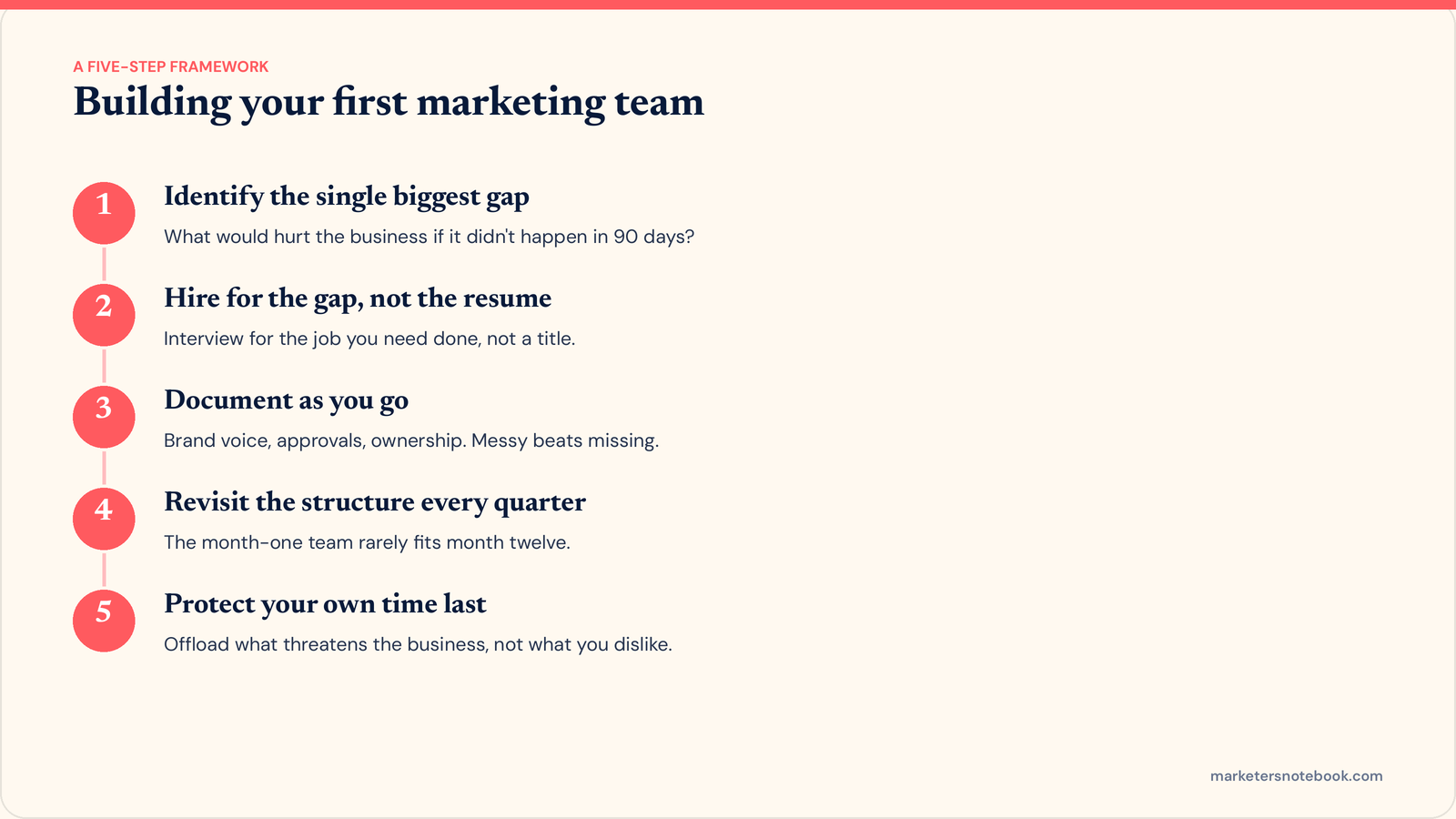
- Identify the single biggest gap. What, if it doesn’t happen in the next 90 days, actually hurts the business? That’s your first hire’s job, not a generic title.
- Hire for the gap, not the resume. Interview for the specific thing you need done, not a title that sounds impressive on an org chart.
- Document as you go. Brand voice, approval flow, ownership. Messy and written down beats perfect and only in your head.
- Revisit the structure every quarter. Ask honestly whether the team that got you here is the team that gets you to the next milestone, and be willing to let roles evolve.
- Protect your own time last, not first. First-time leaders often hire to offload the work they enjoy least, when they should be hiring to offload the work that most threatens the business. Those aren’t always the same thing.
None of these steps are complicated. What’s hard is doing them in the order that matters when you’re moving fast and every hire feels urgent.
Frequently asked questions
What should my first marketing hire be?
It depends entirely on your biggest gap, not a standard org chart. Identify the one thing that most threatens the business in the next 90 days and hire specifically to close that gap, whether that’s demand generation, content, or brand.
Should I hire generalists or specialists when building a team from scratch?
Early on, it’s tempting to hire generalists for flexibility, but a specialist who closes your most urgent gap usually delivers more value than a generalist spread thin. Reserve generalist hires for when you genuinely don’t yet know what the team needs most.
How long does it take to build a functioning marketing team?
In my experience, expect 60-90 days before a small team starts operating smoothly, and closer to six months to a year before the structure and processes feel stable. Building a team from scratch is a process, not a single event.
What’s the biggest mistake first-time marketing leaders make when building a team?
Assuming the team and structure that works for the first few months is the final shape of the team. The business changes, and the team needs to change with it, both in roles and in who’s doing what.
How do I avoid becoming the bottleneck as I build my team?
Document decisions as you make them, even informally: brand voice, approval processes, and ownership. The moment you have a second person on the team, anything living only in your head becomes a delay for someone else.
Conclusion
Building a marketing team from scratch will teach you more about your own gaps as a leader than it will about anyone you hire. The advice that gets repeated most, hire a generalist first, follow a standard org chart, is rarely the advice that actually fits your specific situation.
If you’re in the middle of your first build right now, I’d love to hear what nobody told you. Drop a comment or send me a message: what was the lesson that surprised you most?