
The short answer
Cold emails that get replies in 2026 are short (under 80 words), open with a real signal at the prospect’s company, and end with a low-effort interest question instead of a meeting request. The average reply rate is 3.43%, and the top 10% of campaigns clear 10.7% (Instantly, 2026). The 10 templates below follow that pattern across a full sequence.
You didn’t start a SaaS company to become a professional cold emailer. But until you hire your first salesperson, outreach is your job, and 2026 has made it harder: inbox filters are stricter, Gmail now summarises threads with AI, and buyers can spot a mail-merged opener in a second.
The good news is that the data is unusually consistent about what still works. Here it is, turned into templates you can copy.
What reply rate should you expect in 2026?
| Benchmark | Source | Reply rate |
|---|---|---|
| Average, all cold email | Instantly 2026 | 3.43% |
| Top quartile of campaigns | Instantly 2026 | 5.5% |
| Top 10% of campaigns | Instantly 2026 | 10.7%+ |
| Sales outreach sequences | Hunter 2026 | 3% |
| Lists of 21–50 recipients | Hunter 2026 | 6.2% |
What should you fix before you send anything?
Four setup fixes that matter more than copy
- Send from a custom domain, never Gmail or Outlook.com. Hunter found custom domains get more than double the reply rate of free email accounts (5.2% vs 2.5%). Set up SPF, DKIM and DMARC first; Gmail and Yahoo now reject mail that fails them.
- Keep each list to 50 people or fewer. Sequences with 21–50 recipients averaged 6.2% replies, against 2.4% for 500+. Small lists force you to write for real people.
- Send like a human. Hunter’s reply rates peaked at 20–49 emails per inbox per day. Keep spam complaints well under Google’s 0.3% ceiling; 0.1% is the safer target.
- Turn off open tracking. Campaigns without it saw 7.4% replies versus 4.4% with it, and Apple’s privacy features make open data unreliable anyway. Track replies and meetings instead.
The 10 cold email templates that work in 2026
Templates 01–07 are one sequence, numbered in send order. If you only want three emails, send 02, 04 and 07. Templates 08–10 are for after someone engages.
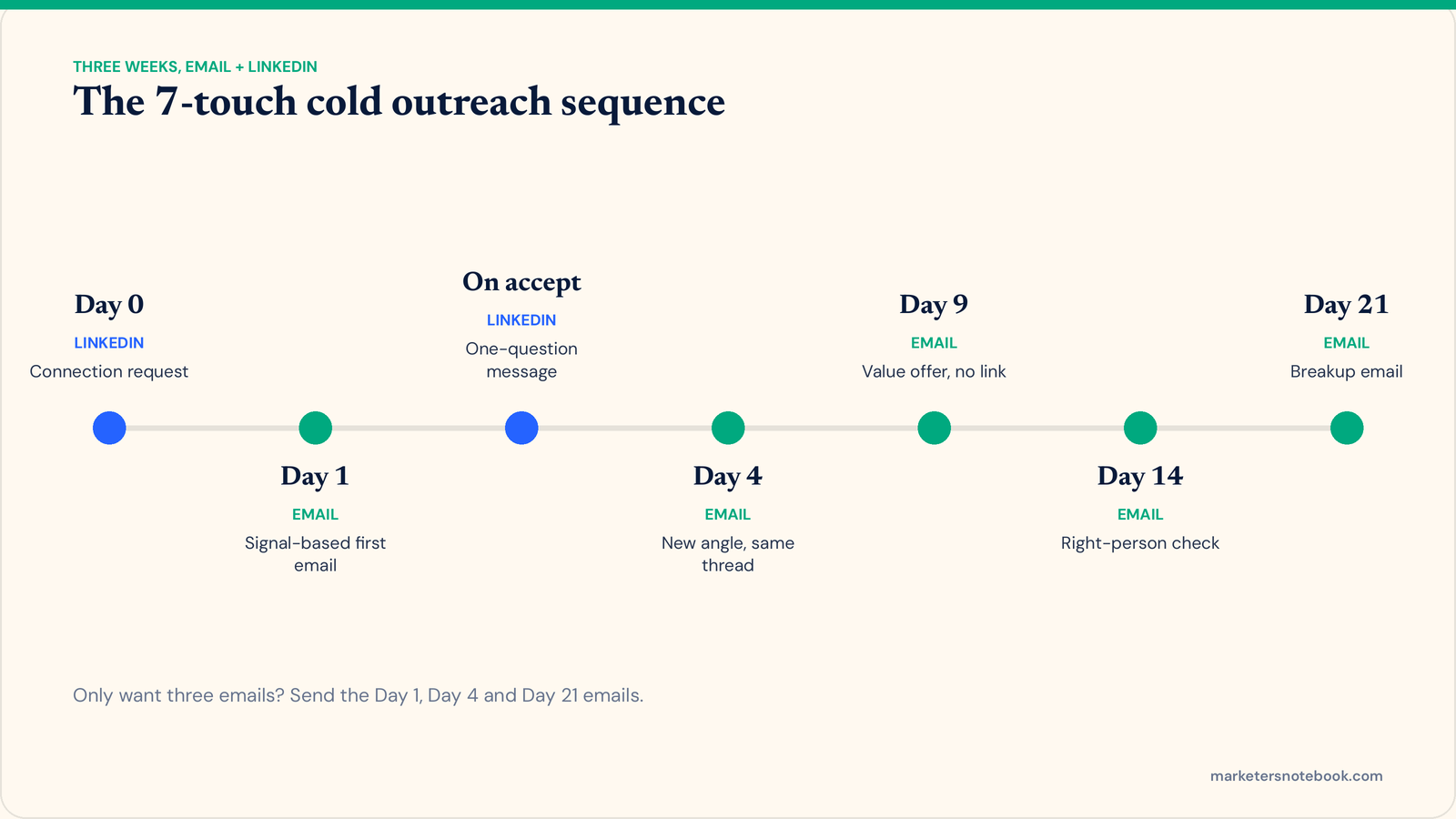
Part 1: The cold sequence
Seven touches over three weeks, mixing email and LinkedIn.
Day 0 · LinkedIn
01The LinkedIn connection request
Send a note only when you have a real reason to connect. If you don’t, send the request blank.
Hi [First Name], your post on [specific topic] made a point I don't see often: [one-line paraphrase]. I work on the same problem from the [your angle] side. Would be good to connect.
Why it works: In Belkins’ data on roughly 20 million requests, a note barely changed acceptance (26.42% vs 26.37%), but people who accepted a noted request replied far more afterwards (9.36% vs 5.44%). The note’s job is the conversation, not the accept. A generic note is worse than none.
Day 1 · Email
02The first cold email (signal-based)
Your most important email. Open with something true and recent about their company, keep it under 80 words, and ask for interest, not time.
Subject: [signal] at [Company]

Hi [First Name],

Saw [Company] is [specific signal: hiring 3 SDRs / just raised / moving upmarket].

Teams at that stage usually hit [specific problem] within a few months, and it tends to show up as [visible consequence].

We helped [similar company] [specific result with a number] in [timeframe].

Worth sending over how they did it?

[Your name]
Why it works: Instantly found the first email drives 58% of all replies in a sequence, and its elite senders stayed under 80 words with a single CTA. Gong’s study of 304,174 emails found interest asks succeeded about 30% of the time on cold emails, double the 15% for a specific-time meeting request.
After they accept · LinkedIn
03The first LinkedIn message
Send within a day or two of the connection being accepted. One question, no pitch, no link.
Thanks for connecting, [First Name]. Curious about one thing: now that [Company] is [signal], how are you handling [problem]? Most [role]s I talk to are split between [option A] and [option B].
Why it works: Hunter’s 2026 survey found 50.5% of decision makers now prefer LinkedIn for outreach, against 25% for email. A question with two concrete options is easy to answer from a phone.
Day 4 · Email (reply in thread)
04Follow-up #1: a new angle, not a bump
Reply to your own first email so the context stays attached. Say something new: a different cost of the problem, or the view from another stakeholder.
[First Name], one more angle on this.

The cost of [problem] usually shows up in [a different place: ramp time, churn, the board deck], not where teams look first.

If it isn't a priority this quarter, a quick "not now" helps me too.
Why it works: Follow-ups produce 42% of replies in Instantly’s data. And with Gemini now summarising threads in Gmail, a string of “just bumping this” notes gets summarised as exactly that, so every touch has to add something.
Day 9 · Email
05The value offer (ask before you send)
Offer one specific, useful thing. Don’t attach it or link it yet. Ask if they want it.
Subject: [topic] benchmarks for [their segment]

[First Name], I put together [specific asset: a one-page breakdown of how 12 Series A teams structured their first outbound hire].

No pitch attached. Want me to send it?
Why it works: Hunter recommends leaving links out of early touches because they look like mass mail to inbox filters, and asking permission gets you a reply, which is itself a trust signal. In Gong and 30MPC’s data, emails that make an offer lift reply rate by about 28%.
Day 14 · Email
06The right-person check
Use when your main contact has been silent. Only move to a second person at the company after this.
[First Name], I may have the wrong person for this.

If [area] sits with someone else at [Company], who would you point me to? Happy to mention you sent me, or not. Your call.
Why it works: Hunter found contacting one or two people per company gets 46% more replies than emailing three or more, so start narrow and widen only when your main buyer goes quiet.
Day 21 · Email
07The breakup email
The last message in the sequence. Under 50 words, no guilt, and one easy way to say “later”.
Subject: close the loop?

[First Name], I haven't heard back, so I'll assume [problem] isn't a priority right now and stop here.

If that changes, reply "later" and I'll check back next quarter.
Why it works: Close reports breakup emails commonly pulling 10% to 33% replies, and HubSpot’s sales team has cited 33%. Treat that as a lift on your existing numbers, not a rescue: if earlier emails get 1%, a strong breakup might get you to a few percent.
Part 2: After they engage
The three moments where most founder-led deals stall.
Same day as the demo
08The post-demo recap
Send within a few hours of the call, 24 at most. Recap in their words, then propose a specific time.
Subject: recap + next step, [Company]

Thanks for the time today, [First Name]. Quick recap so we're aligned:

What you're solving: [their problem, in their words]
What mattered most: [1–2 things they reacted to]
Still open: [the one unresolved question]

Next step: [specific action]. Does [day] at [time] work to [purpose]? I'll bring [what you'll prepare].
Why it works: This is where the ask flips. In Gong’s data, a specific-time request succeeded 37% of the time once a deal was live, versus 15% on a cold email. Now that they’ve shown interest, remove the scheduling work for them.
3–4 business days after their decision date
09Silent after the proposal
For a deal that went quiet after pricing. Make replying a one-word job.
Subject: [project name]

[First Name], checking in on the proposal from [date]. No pressure either way. A quick read on where it landed helps me plan.

Which is closest?
1) Still on, but timing slipped
2) Waiting on someone else to weigh in
3) Not a fit this time

Just the number is plenty.
Why it works: Gong found open-ended asks lost in both cold and live-deal situations. A numbered list turns an awkward “we went another way” into a one-character reply, and option 3 gives them permission to be honest.
90–120 days after it stalled
10The re-engagement email
For a lead that went cold or a deal you lost on budget or timing. Open with the original objection and what has changed since.
Subject: picking up from [month]

[First Name], when we spoke in [month], [original blocker: budget / timing / another priority] was what stopped this.

Since then, [what changed: a smaller starting plan / the integration you asked about / a result from a team like yours].

Does that change anything on your side?
Why it works: Cleverly recommends waiting 90 to 120 days on budget losses, since budget cycles reset, and using the original objection as the hook. It shows you listened the first time and gives them a real reason to reply now.
How do you adapt these templates without breaking them?
- Replace every bracket with something you actually found. Hunter found emails with two personalised details got 5.6% replies versus 3.6% with none. A hiring post or funding round you spotted in two minutes counts.
- Write it the way you’d say it. Lavender’s data links simple, conversational writing to far more replies than formal business prose. If you wouldn’t say a sentence on a call, cut it.
- Keep subject lines to 2–6 words and skip “quick question”. Hunter found that overused pattern underperformed other subject lines (2.5% vs 2.9% replies).
- Let AI research, and write the final draft yourself. 69% of decision makers in Hunter’s survey said AI-written email bothers them unless it feels genuinely human, and hand-edited emails got 18% more replies.
- Retire what doesn’t work. After about 50 sends per template, drop anything that’s well below your average and test a new first line.
Frequently asked questions
What is a good cold email reply rate in 2026?
Instantly’s 2026 benchmark puts the average at 3.43%, the top quartile at 5.5% and the top 10% of campaigns above 10.7%. Hunter’s 2026 report puts sales outreach sequences at 3% on average. Anything consistently above 5% is strong; below 1% usually points to a deliverability or list problem, not the copy.
How many follow-up emails should I send?
The data disagrees, so test it. Hunter’s analysis of 31 million emails found three total emails performed best and longer sequences did worse. Instantly found follow-ups produce 42% of all replies. A safe default is three to four emails plus one or two LinkedIn touches, with every message adding something new.
Should I ask for a meeting in my first cold email?
No. In Gong’s analysis of 304,174 emails, asking for interest succeeded about 30% of the time on cold emails, compared with 15% for asking for a specific time. Once a deal was active, the specific-time ask won at 37%. Ask for interest first and propose times after they reply.
Should I add a note to a LinkedIn connection request?
Only if you have a real reason to connect. In Belkins’ data from about 20 million requests, acceptance was almost identical with and without a note (26.42% vs 26.37%), but people who accepted a noted request replied more often afterwards (9.36% vs 5.44%). A generic note does more harm than no note.
Can I use AI to write cold emails in 2026?
Use it for research and first drafts, then edit by hand. Hunter’s 2026 survey found 69% of decision makers are bothered when an email was written with AI unless it feels genuinely human, and manually edited emails got an 18% higher reply rate than fully automated ones.