
ChatGPT ads are now open to any US business through a self-serve Ads Manager with no minimum spend, and they’re expanding fast, which has a lot of small business owners asking one question: is this the next big marketing channel, or another test budget about to disappear into a reporting gap?
Here’s the honest answer. The channel is real and growing, and OpenAI is building out the measurement behind it. But some agencies running early campaigns have reported missing conversions, click counts that don’t match their own analytics, and conversions arriving 24 to 36 hours late. That’s not a reason to ignore ChatGPT ads. It’s a reason to test them differently than you’d test a new Google or Meta campaign.
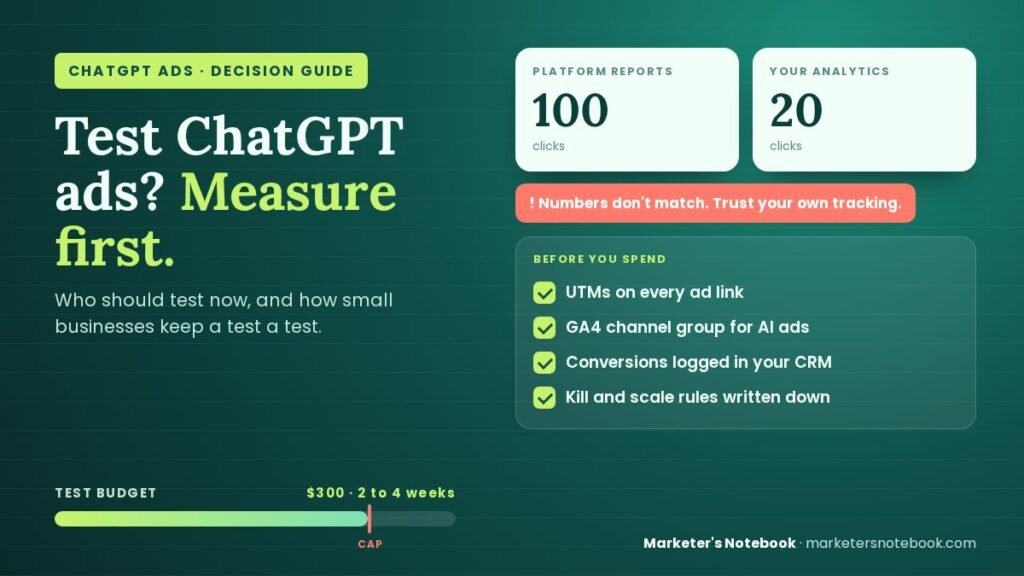
Quick answer: Test ChatGPT ads only if you already have reliable GA4 and CRM tracking, a small budget you can afford to learn from, and no need for same-day numbers. Before launch, tag every link with UTMs, log conversions in your own system, cap the budget, and write down your kill and scale rules.
What’s new with ChatGPT ads?
OpenAI started selling ads in a paid US pilot on February 9, 2026, then opened a self-serve Ads Manager to all US businesses on May 5 with no minimum spend, adding a conversion pixel, a Conversions API and cost-per-click bidding. Ads appear as a “Sponsored” card below a ChatGPT answer, and they’re shown to logged-in adults on the Free and Go plans; paid plans like Plus and Pro are ad-free.
On October 5, 2026, OpenAI added two things (Relevant Audience has the full breakdown):
- 20 third-party measurement partners, including attribution tools like AppsFlyer, Adjust and Branch, ecommerce tools like Triple Whale, and incrementality specialists like Haus.
- An image-led ad format, which OpenAI is testing first inside ChatGPT’s image generation with an initial group of US advertisers. Most small businesses won’t have it yet; the standard sponsored card is what you’ll actually be buying.
What problems are advertisers reporting?
Digiday’s reporting found measurement is the sticking point in most conversations about ChatGPT ads, though the problems aren’t universal:
- Missing conversions. One agency ran a UK lead-gen campaign, watched form fills arrive, and two weeks later the platform still showed zero conversions.
- Click discrepancies. The same agency saw about 100 clicks reported by ChatGPT against roughly 20 in its own tracking. Other agencies said they hadn’t seen this.
- Reporting lags. Another agency sees conversions arrive 24 to 36 hours late, versus a few hours on Google, with no demographic or prompt data in reports.
- Tracking terms. Conversion tracking requires accepting OpenAI’s tracking terms, which some advertisers’ legal teams won’t sign.
None of this makes ChatGPT ads a bad idea for a small business. It means the channel is at the stage where you test with your own measurement in place, not OpenAI’s dashboard alone.
Who should test ChatGPT ads right now?
You’re a good candidate to test ChatGPT ads now if:
- You already have reliable baseline tracking. If GA4 and your CRM are accurate today, you’ll spot a measurement gap when it shows up. If your tracking is shaky everywhere, fix that first; a new channel won’t fix it for you.
- You have a budget you can afford to learn from. Treat it as money you may not get a clean ROI read on for a month or two while measurement catches up.
- You sell in an eligible market and category. Ads started in the US and OpenAI says they now run in more than 60 countries, but access and self-serve vary by market. OpenAI also restricts some regulated categories, so check its ad policies before planning a test.
- You don’t need same-day numbers. If your team needs real-time results to approve spend, a 24 to 36 hour lag will frustrate rather than inform.
If none of those describe you, it’s reasonable to wait a quarter and let the next wave of advertisers generate the data. In the meantime, check how your brand already shows up in ChatGPT’s answers for free: my guide on how to track AI visibility in Claude or ChatGPT takes 20 minutes.
How to measure ChatGPT ads independently before you spend
This is the step most testing guides skip, and it’s the one that protects your budget. Before your first ChatGPT ad goes live:
1. Build a dedicated UTM structure
Tag every ad link with a consistent, documented UTM structure (source, medium, campaign) so you can isolate this traffic in GA4 whatever OpenAI’s own dashboard shows.
2. Create a separate channel group in GA4
Set up a custom channel group for “AI assistant ads” so this traffic doesn’t get folded into Direct or Paid Other, which makes it impossible to judge on its own.
3. Log conversions in two places
Record conversions in your own CRM or a spreadsheet the moment they happen, not just in OpenAI’s reporting or a measurement partner’s. A second source of truth catches a missing-conversion gap before it costs you a scaling decision.
4. Match your review cadence to the lag
Review performance every 48 to 72 hours, not daily, so you’re not reacting to numbers that are still settling.
How much should you budget to test ChatGPT ads?
Write these numbers down before launch, not after the first week of results.
- Test budget cap: a fixed amount, small enough that a measurement gap doesn’t hurt and large enough to produce a signal. For most small businesses, that’s a few hundred dollars over 2 to 4 weeks. Third-party guides estimate clicks at roughly $3 to $5 each, so $300 buys somewhere around 60 to 100 clicks; check your own Ads Manager for real bids.
- Kill criteria: the number that tells you to stop. For example, cost per lead more than double your best existing channel, measured by your own CRM-logged conversions, not OpenAI’s reported ones.
- Scale criteria: the number that tells you to add budget. For example, cost per lead at or below your best channel, confirmed by your own tracking for at least two reporting cycles.
Writing these down in advance keeps the decision about the data, not about how the campaign feels in week one. It’s the same “test before you trust” rule I use for Meta’s AI ad tools.
The bottom line
ChatGPT ads are worth testing for a small business that already has solid tracking, a budget it can afford to learn from, and an eligible market and category. ChatGPT ads aren’t worth testing yet if your existing measurement is shaky or your team needs real-time numbers. Either way, the advertisers getting burned right now aren’t the ones testing this channel. They’re the ones testing it without a second set of eyes on the data.
FAQ
Are ChatGPT ads worth testing for a small business right now?
They can be, if you already have reliable GA4 and CRM tracking, sell in an eligible market, and have a test budget you’re comfortable learning from for a month or two. If your existing measurement is shaky, fix that first.
Can any small business run ChatGPT ads?
In the US, yes: self-serve opened to all US businesses on May 5, 2026 with no minimum spend. OpenAI says ads now run in more than 60 countries, but access varies by market and some regulated categories are restricted, so check availability and policies for your business.
How much should I budget to test ChatGPT ads?
Most small businesses can get a usable signal from a few hundred dollars over 2 to 4 weeks. Treat it as a capped test with written kill and scale rules, not an open-ended spend.
Why don’t platform conversions match my own analytics?
Some agencies have reported missing conversions, click discrepancies and conversions arriving 24 to 36 hours late. Tag links with UTMs and log conversions in your own CRM or spreadsheet so you have an independent source of truth.
Do I need one of OpenAI’s measurement partners?
Not to start. The 20 partners OpenAI named in October 2026 are useful for larger advertisers, but a small business test can run on UTMs, a GA4 channel group and CRM-logged conversions. Treat partners as a second opinion, not your only source of truth.
What’s a good kill or scale rule for a new ad channel test?
Decide before launch. A common approach: stop if cost per lead, measured by your own tracking, is more than double your best channel; scale if it matches or beats your best channel for at least two reporting cycles.